Samurai Society: An Exploration of Japaneseness in post-war Jidaigeki and Contemporary Anime
November 25, 2017 Leave a comment
One of the defining images of Japanese history and culture, is that of the samurai, warriors with a strict code of ethics, and a singular dedication to mastering the ways of war. Many of Japan’s most famous historical figures are samurai lords; Oda Nobunaga (1534-1582); Toyotomi Hideoyoshi (1537-1598), and Tokugawa Ieyasu (1543-1616) to name but a few, have also become famous outside of Japan, and yet, even at the height of their power during the Edo-period, samurai numbered less than 10% of Japan’s total population. Interpretations of their values and ideals, instrumental in the growth of the Japanese nation, have also been important to the creation of a modern nation-state; readily visible in their ubiquitous presence within Japanese popular culture, from the immediate post-war period cinema, to contemporary anime series, and films. While many jidaigeki films (時代劇, period drama) are set in different periods throughout Japan’s history, the Edo-period (1603-1868) when the Tokugawan Shogunate ruled stands out as one of the most interesting.

While Samurai have a long history stretching back to the Heian period, I focus on representations of Edo-era samurai, a period when the unwritten rules, roles, and social standings were solidified and codified. Characterised by economic growth, strict social structures, isolationism, and a relatively stable population, it was a period of relative peace that saw the codification of the samurai as their position and martial skills gradually changed from the practical towards the symbolic. Such relative stability, coupled with a strict social structure, and policies that sapped regional daimyo (Feudal lords) of their power meant that during the Edo-period a complex system of arts, crafts, and culture thrived. Martial skills took on a more symbolic role, where the aim was to achieve martial perfection and ultimately, enlightenment, rather than training in the practical arts of killing. This period is also essential to an exploration of Nihonjinron, or Japaneseness in post-war Jidaigeki, as it represents a period of perceived supremacy before the forced incursions by foreigners (Commodore Perry’s Black Ships). Throughout Japan’s history there had been a steady flow of foreign trade and knowledge, strictly controlled by those in positions of political power. As such periods like the Edo-era are often portrayed as pure, and untouched, when uniquely Japanese culture free from outside influence is at its height, and has therefore served as a key setting for jidaigeki, to draw upon the tradition and history of samurai culture to reinforce Japan’s uniqueness. In the context of this article I focus on the idea of Nihonjinron and its relation to theories regarding the unique qualities of Japanese culture, society and history, and its presence in popular cultural forms that focus on Japanese historical past. I also use it in the context of Harumi Befu’s (2001) work on Nihonjinron as a tool for enforcing social and political conformity through the creation of ‘uniquely’ Japanese aesthetics, cultural ideals, and social actions that help the Japanese state in creating a homogenised Japanese society.
Using representations of Tokugawan-era samurai in Jidaigeki (period drama) from the immediate post-war period, alongside contemporary images found in anime, I will explore the continued importance of Samurai to the creation of the Japanese state, and ideas of Japaneseness in modern Japan. Inagaki Hiroshi’s Samurai Trilogy (1954-1956) represents a classic piece of post-war period drama (and arguably epitomises the post-war periods representation of the historical samurai, alongside revised depictions of ‘Japaneseness’ as a concept of modern Japan’s place in the world), while Oshima Nagisa’s Gohatto (御法度/Taboo – 1999), offers a more complex look at samurai, through the problematisation of their position within contemporary Japanese cultural and social discourse. Furthermore, I will be focusing on two Jidaigeki anime series; Onihei (鬼平) (2017, adapted from a series of historical novels by Shotaro Ikenami), set in Edo during the 18th century, and focusing on Edo’s police force; and Katsugeki Touken Ranbu (活撃 刀剣乱舞)(2017), an unusual series that presents a series of anthropomorphised, time traveling swords, tasked with defending Japan’s historical past in order to ensure the safety of the country’s future. All of these cultural texts are set either during the Edo-period, particularly during the second half of that era, when Tokugawan society was at its height, and in particular during the Bakumatsu period, when Tokugawan society was in decline. Significantly, the last two centuries of Tokugawan rule were arguably when the Samurai’s social status had full stabilised, and were at an apogee, a period that seems fixed in the Japanese imagination as the zenith of Japanese cultural and martial achievements, despite the presence of other, more distant eras with significant cultural and social influence on modern Japanese thought, culture, and social structures.

These films, and series, provide a broad look at depictions of samurai from the post-war period through to contemporary culture, and illustrate the complex place that such figures have in Japan today. They also serve to highlight the rich variety of imagery associated with the historical samurai, and the varied means with which these semi-mythical figures have been portrayed over the last seventy years. In doing so I seek to interrogate the use of samurai and the historical past in theories of Nihonjinron, or ‘Japanesness’, while further examining, and problematising the continued importance of samurai in the creation of a modern Japanese state. I argue that it is essential to investigate contemporary images of the samurai found in anime such as Katsugeki Touken Ranbu (2017), and Onihei (2017) alongside genre classics such as The Samurai Trilogy, and more complex films such as Gohatto. The richness of the imagery used in such anime and films embodies a cultural ideal, representing a golden period, where a distinctly Japanese culture, and belonging can be found. However, as with any representation and interpretation of the historical past, these depictions of samurai are selective, often ignoring many of the more problematic elements of the period in favour of heroism and gallantry. The Samurai Trilogy (1954-1956) represents this vision of Japan, idealistic, romantic, and uniquely Japanese, whereas Gohatto (1999) offers a more complicated vision of the samurai and their place in society. In contrast, Onihei (2017), and Katsugeki Touken Ranbu (2017) represent the complex centre ground, simultaneously problematising the romanticised visions of samurai, whilst also offering a very conservative reading of their place in Japanese history, and the roll of the samurai code of bushido in modern Japan.
Post-war samurai films, or ‘Jidaigeki’ (period drama) represented a renewed interest in the cultural foundations of Japanese society, part of a broader search for national and cultural identity that embodied notions of Japan’s unique place in history in a newly globalised world. The samurai in such films, and more recently in numerous anime series, while (mostly) fictional figures, are grounded in a version of Japan’s historical past that has been embellished by oral traditions, isolated from the problems and insecurities of an unfamiliar period, thereby elevating them to the level of myth (Silver, 1977). Jidaigeki, like The Samurai Trilogy, present mythical, often tragic heroes who both push against authority, while also conforming to widely held cultural and social norms. The reality of historical figures, such as Miyamoto Musashi (The Samurai Trilogy), is replaced by the legend of someone who is seen to embody essential elements of ‘Japaneseness’ (to a contemporary audience), alongside true power and prestige of the Japanese people. Separating reality from legend may often be impossible, as the representations of samurai and Japan in post-war Jidaigeki are so important to the creation of Japaneseness, as to be embedded within the very fabric Japanese society and culture. And arguably such representations have been further reinforced and deeply embedded in Japan’s popular imagination through their inclusion in numerous Jidaigeki anime, computer games, and manga. It is the legend of the samurai, and in particular, what the samurai of Tokugawan Japan represent that is important to the creation and re-creation of Japanese national identity. The vast superiority of the samurai and their place in Japanese society is expressed with striking clarity in the traditional aphorism ‘Hana wa sakura ni, hito wa bushi’ (花は桜木人は武士), ‘Among flowers the cherry, among men, the samurai’, meaning that as the cherry blossom is considered foremost among flowers, so the samurai were seen to be undisputed among men (Blomberg, 1994; XI-XII). Even more evocative is the parallel between Camellia and the samurai, as camellia blossoms do not wither, but instead suddenly drop, suggesting that the samurai tradition will neither wither nor fade (Blomberg, 1994).

Neo-Confucianism or Shushi-Gaku (朱子学 ) emphasised social hierarchy and filial-piety, whilst also introducing distinct elements of ethnocentrism, and nationalism, to a now unified Japan; social structures that also informed the creation of bushido, the codification of samurai moral values, such as frugality, loyalty, martial arts mastery, and honour until death, thus allowing the violent existence of the samurai to be tempered by wisdom and serenity. It was an unspoken, and unwritten code of moral principles that samurai were required to observe, a code that had organically grown, changed, and been adapted over the centuries of military rule and conflict throughout Japanese history, and was one that all samurai were required to master to be considered a true warrior (Friday, 1994; 340). However, towards the end of the Tokugawa Shogunate, samurai lost their place in a society controlled by an elaborate series of social structures, that created a rigidly hierarchical society based on Neo-Confucianism ideals. Given the social rigidity, and relative peace of the time, the samurais, martial prowess no longer had any significant use in the control of social hierarchies, as such, the samurai as warriors had gradually become little more than civil servants and bureaucrats. The gradual erosion of their position in this society, coupled with the codification and internalisation of bushido, and the ethnocentrism of the Edo period resulted in the creation of an official nationalism, informed by imperialist tendencies, towards the end of the Shogunate, and early Meiji period. As Anderson (1983) notes, after 1854 (Perry’s Black Ships), the self-confidence and inner legitimacy of the Bakufu (Tokugawa Shogunate) were rapidly undermined by a conspicuous impotence in the face of the colonial expansion of the West. Under the banner of Sonno Joi (Revere the Emperor, Expel the Barbarians), a small band of middle-ranking samurai, primarily from the Satsuma and Chosshu Han (Feudal Domains), finally overthrew the Shogunate 1868 (Anderson, 1983; 94). However, once in power, the rebels, remembered today as the Meiji Oligarchs, (a comment on the ability with which some samurai retained their positions of power), found that their military prowess did not automatically guarantee political legitimacy. Furthermore, because their military victories were the result of collaboration with the west, through trade with a Scottish merchant in order to acquire modern weapons and military strategies, thus running counter to the ideas of Sonno Joi, there was an unease regarding the position of Japan in an increasingly complex world. Even If the Tenno (Emperor) could quickly be restored with the abolition of the Bakufu, the (western) barbarians could not so easily be expelled, and so Japan’s geopolitical uncertainty remained as fragile as before, thus bringing into question the aims of the rebellion (Maki, 1945; 146-47). One of the basic means adopted for consolidating the oligarchy’s domestic position was thus a variant of mid-century ‘official nationalism rather conspicuously modelled on Hohenzollern Prussia-Germany (Anderson, 1983; 95). This modern nationalism as Friday (1994) argues, was closely bound up with the notion of a Japanese ‘national essence’, or ‘Japaneseness, and with those of the kokutai, or Japanese national structure, and the cult of the emperor. Such nationalism was a propaganda tool, one consciously shaped and manipulated as part of the oligarch’s effort to forge a unified, modern nation out of a fundamentally feudal society, and to build a modern national military composed of conscripts from all tiers of Japanese society (Friday, 1994; 342). Such official nationalism mingled with understandings of bushido to further legitimise the use of violence in the name of the emperor and in defence of what was becoming a modern (western) nation-state.
The samurai code of bushido had been re-interpreted and altered to fit the Meiji and pre-war periods, with bushido coming to represent the aggressive nationalism and jingoistic excesses of the time. But its central qualities of loyalty, dedication and perseverance as embodied in films like The Samurai Trilogy (and more recently in anime like Katsukgei Touken Tanbu, and Onihei) have deep roots in the Japanese character. Qualities which gained increased importance in the post-war years of rebuilding and recreating a uniquely Japanese socio-cultural identity (Japaneseness), that dispensed with the jingoistic excesses of the pre-war era, while maintaining the strength and perceived superiority of the historical samurai alongside modern understandings of bushido (Blomberg, 1994; Hook and Hiroko, 2007). A traditional Japanese hero like Miyamoto Musashi (The Samurai Trilogy) represents the historical samurai culture in all its original glory, as both critique of the present in terms of the historical past, while also a figure embodying cultural and social norms to aspire to (Thornton, 2008). Similarly, characters in anime such as Onihei, and Katsugeki Touken Ranbu represent images of a glorious past; Hasegawa Heizo (Onihei) for example is noble, steadfast, and honourable, a character who stands up to those who would steal, deceive, and destroy, while also showing a patriarchal kindness to those he cares for. Encapsulating the acceptable qualities of Edo-era samurai, by repetitively focusing on such individuals, they come to represent the historically and culturally diverse samurai caste as if it were a single homogenous, and historically isolated group.

Such figures have assumed mythical proportions, the romantic aura of heroic individuals reflecting a glorious past; their universality representative of the plight of all Japanese, their historicity standing as valid proof of an unbroken culture that still represents Japan in the modern world (Thornton, 2008; 51). Unlike the Meiji and later periods where national defence and military victories were propogandised through schools and print, depictions of samurai in Jidaigeki, during the post-war period, had become increasingly valuable in creating the general impression that their socio-cultural conservatism was an authentic representation of the nation which had been rebuilt since the catastrophes of the war (Anderson, 1983; 97). Miyamoto Musashi (The Samurai Trilogy), Hasegawa Heizo (Onihei), and Izuminokami Kanesada (Katsugeki Touken Ranbu) represent interpretations of the historical samurai to inspire an audience; strong, steadfast, but also honourable, and with an ability to show humility and care. Samurai to fit a modern world, old, yet also contemporary. By refusing to acknowledge defeat or become a victim, to act in a good, and righteous manner (according to a modern interpretation of bushido), such figures become the acceptable face of Japan’s bushido tradition and reformulate what it means to be Japanese, through a re-evaluation of bushido in a manner that retains its essential qualities, while dispensing with any notion of aggressive nationalism, in the process reaffirming Japanese uniqueness and strength.
The Samurai Trilogy is a particularly important series of films in the exploration of Japaneseness in contemporary culture as it presents a highly traditional view of Japan, with idyllic representations of a more pristine way of life where Zen and the sword take precedence over everyday matters such as having enough food, or money (Creighton, 1997; 240). As Musashi travels on his long journey of self-discovery we are presented with a very narrow portrayal of Japan, the politics and social norms of the time ignored. What it means to be Japanese is highly prescriptive, offering conservative models to be emulated by the country during the immediate post-war years, a time of immense socio-cultural and political change (William Davis, 1996; 2). This picture of Japan is further emulated in Onihei, taking cues from earlier jidaigeki, while also portraying a greater cross-section of Edo-era society, albeit in the very narrow confines of Edo life from the perspective of its police force, and institutionalised samurai that are part of the broader socio-cultural rigidities of Tokugawan Japan. In focusing on the Edo police force during the middle of the 18th century, Onihei highlights the middle of the Edo-era, when the Tokugawan hegemony was arguably at its height, and samurai were gradually losing their original purpose as warriors in a comparatively peaceful, and rigid society. While the history of the samurai was one of ever-changing alliances and political power, the images of Japan in Onihei represent a never-ending idyll, where Japanese culture is codified, and social structures are fixed and pristine, free from potential corruptions or outside influences.

By distinguishing Japan from other countries through the portrayal of an acceptable form of bushido, post-war Jidaigeki such as the Samurai Trilogy, alongside contemporary anime (1997-present, although a significant number of series and films have been produced in the last decade, and a number of samurai themed anime were produced between the 1960s and early 1990s), present the historical past as a place of reified culture and tradition. However, in presenting a series of codified values, while also reducing Japanese history and culture to a simplistic set of ideas and aesthetics, such jidaigeki produce a highly restrictive view of Japan (Casebier, 1987). In doing so, representations of Tokugawan Japan come to represent Japan’s entire historical tradition, and while there are acknowledgments of an older, more complicated history, the audience is largely presented with a one-dimensional interpretation of a multifaceted history. The pre-eminence of Tokugawan Japan in jidaigeki films and anime series suggests that the complex and fascinating history of Japan’s warrior caste have been reduced to one specific period, the culmination of the countries warrior traditions, and genesis of ‘acceptable’ culture. Such a portrayal excludes elements of culture and history that are seen to be unacceptable or go against widely held notions of Japaneseness, and the country’s historical complexities (Bukh, 2007).
One of the principle elements of Japanese culture that post-war jidaigeki ignores is that of homosexuality or ‘shu-do’ (an abbreviation of wakushu-do, the way – do – of the ephebe, wakushu) (Watanabe, 1989; 11) that have a long history in Japanese, and in particular samurai aesthetic tradition. Nagisa Oshima reintroduces these aspects of Japanese aesthetic culture in his film Gohatto (1999), portraying them as part of everyday life, and also a part of broader bushido tradition and practice. While Gohatto still presents a modern interpretation of bushido and samurai, it also seeks to reintroduce aspects of samurai culture that had been conveniently forgotten or deemed unacceptable for a ‘modern’ country. In Japan, every art and every technique can become a way towards awakening if it requires a long and difficult apprenticeship. It is possible to search for awakening by the Way of Buddha (Butsu-do), or the Way of the Gods (shin-to), the Way of the Bow (kyu-do), or, by the Way of Suppleness (ju-do), of even the Way of Tea (sa-do), or Calligraphy (sho-do) (Watanabe, 1989; 48). Similarly, shu-do (the way of young men) was an important and highly prestigious Japanese tradition that was considered as, if not more important and noble than many other better known traditional Japanese arts. These young men were beautiful and heroic, willing to die alongside their lord in battle as the ultimate sign of love and devotion, or in later periods without constant warfare, scarring their arms or tattooing themselves as a similar sign of devotion and love. It was a highly-codified practice governed by strictly defined rules, but one that may ideally develop into a life-long bond of friendship and devotion, informed by the samurai’ notions of honour and dedication.

Watanabe (1989) describes Japan as having a long history of homosexuality, and especially Pederasty (the love of an adult male for an adolescent boy) during the 16th, 17th and 18th centuries (and possibly much earlier), something that only disappeared with the advent of modernisation, industrialisation and the destruction of bushido (Watanabe, 1989; 11). As Watanabe (1989) argues, the Japanese consider homosexuality to be a perversity of morals peculiar to the Japanese ancien regime; they look on it as one of the signs of the ‘underdevelopment’ of Japanese society (Watanabe, 1989; 11). By ignoring historically important elements of Japan’s history, while also exclusively focused on The Way of the Sword (ken-do), films like The Samurai Trilogy, or anime like Onihei and Katsugeki Touken Ranbu reduce Japanese culture to a highly ritualised and codified state, and in the process, eliminate the socio-cultural and political complexities of Japan’s historical past. In so doing, such cultural texts present a conservative image of a social caste, and lifestyle full of immense complexity and sophistication – whereby the multifaceted intricacies of bushido that informed a warrior’s daily life are reduced to simple rules of engagement and Budo (Japanese Martial Arts), rather than a series of social, cultural, and aesthetic traditions that helped to inform many of Japan’s traditions such as tea ceremony, painting, and poetry. In classics of the jidaigeki genre, such as The Samurai Trilogy, this history has been ignored, and instead we are presented with a quintessentially Japanese hero in the form of Miyamoto Musashi, along with a grand narrative of what it means to be Japanese. It is a recreation, or retelling of Japanese history that focuses on aspects of culture deemed acceptable, while ignoring those that are not.
William Davis (1996) talks about the ‘monumental style’ in Japanese cinema, whereby Japaneseness was carefully guarded, respected, codified, and set in direct opposition to what many perceived as the ‘excessive’ westernization of Japan (William Davis, 1996; 4). Sword fights are shot with a reverential touch, set against the backdrop of classically ‘Japanese’ backgrounds, including shrines, temples, bamboo, and sakura, all designed to present Musashi’s mastery with the sword as an indelible facet of Japanese history, one ingrained into the Japanese character. The Samurai Trilogy canonises Japanese history, with an emphasis on the indigenous art forms and designs, while also showing a highly ceremonial set design and acting style. By focusing on the life of Miyamoto Musashi, this trilogy is thus set in a particular time and place perceived to be untouched by the West or other ‘outside’ cultures. The ‘Japaneseness’ that is on display in The Samurai Trilogy is quite different from that of Gohatto, it is a highly codified, almost reductive notion, with ‘Japaneseness’ coming to mean something wholly unique to Japan. By comparison, Oshima’s film reintroduces aspects of Japanese cultural tradition and history that had either been ignored or forgotten about, and incorporates them into a film which critiques Japanese modernity and the whole notion of ‘Japaneseness’. Oshima presents a country that is struggling with its own national identity and place within the world, and while Japanese society in Gohatto may resemble the ‘official version’ as seen in The Samurai Trilogy, it is one where internal conflicts and issues of what it means to be Japanese are visible.

The central issue of Musashi’s dilemma, the Gordian knot of his own inner quest, so to speak, is how to reconcile self-effacement and Zen with self-aggrandisement and the sword (Buruma, 1984; 140). This central dilemma remains valid in modern Japan, and as Hook and Hiroko (2007) argue, the post-war state combines elements of both continuity and discontinuity from the pre-war (and earlier) state, including the state’s relationship with the citizen, but the proliferation of the war-renouncing constitution should be seen as a watershed in changing the relationship between the state and citizens (Hook and Hiroko, 2007; 98). As we watch Mifune’s portrayal of Musashi Miyamoto we see a figure that dispenses with the more rigid elements of early Tokugawa society, and yet never fully questions the state of society and whether being a Samurai automatically provides him with particular benefits that others lack. Musashi in these films, like many other post-war heroes and anti-heroes is fully aware of the intransigent nature of societies judgments, and their violent responses are invariable and understandable both as generic constructions and simple, desperate acts (Silver, 1977; 37). The warriors of Onihei, The Samurai Trilogy, and Katsugeki Touken Ranbu are often estranged from their environment, and many move through periods of high social and political instability during the Edo-period and beyond without ever fully interacting with them. Their violence functions as both an existential affirmation of their being and the most direct method for delineating their oppressed relationship to that environment (Silver, 1977; 38). But, this central dilemma of consolidating two apparently opposing views of the world is one that Japan went through during the post-war period and arguably still has to deal with in the present day. If we take away Zen and the sword, neither of which really plays a significant role in modern Japanese society, one is still left with the paradox every Japanese adolescent must face: how to be an achiever, which is what is expected, particularly by one’s family, and a self-effacing conformist at the same time? This dilemma is about how to be a winner in a society that discourages individual assertion (Buruma, 1984; 140). Indeed, such a dilemma is visible in all manner of Jidaigeki anime, thus suggesting that these issues remain central to Japan’s socio-cultural structures, enduring as a key area of debate and youth rebellion.
The samurai in Gohatto do not have these same dilemmas, to them their duty to protect the Shogunate is of upmost importance, and they are not focussed on any path of Awakening, instead, their sword skills serve a practical purpose to defend the Shogunate and protect their lives. Oshima brings back the practicality of wielding a sword, and instead of it being a method of achieving enlightenment; it is a practical tool with a very specific use. Killing in Gohatto is shown as a natural part of a Samurai’s life, and while the film isn’t the most violent jidaigeki, the efficiency of these fights further reinforces the prominent and important place that the samurai and their katana have in Japanese culture. They also differ from the stylised and lengthy fights in The Samurai Trilogy, which were portrayed as a show of skill, rather than an act in efficiency. Also, by portraying the katana as a practical tool, one used for defence of a cause or an individual, Oshima further situates his film in a time of social and cultural change. Tokugawa society is not merely a backdrop for one individuals quest, but a place and time that is inhabited by a wide variety of people with different attitudes and ideals (Caldararo, 2003). Although, even in Gohatto the focus is largely on the samurai in the Shinsengumi than the rest of Tokugawa society, the social make-up of Tokugawan society, and by extension the Shinsengumi is far more prominent than in The Samurai Trilogy, and plays a more active role in Oshima’s exploration of Japanese society and culture.

Jidaigeki anime further complicate matters in their portrayal of a historical Japan that is both a reinforcement of the acceptable images found in post-war jidaigeki like The Samurai Trilogy, whilst also offering a reinterpretation of the historical samurai, with a reintroduction of elements of their culture that were previously ignored. Whereas Mifune’s Musashi (The Samurai Trilogy) is a very gruff, rough looking warrior, the samurai found in Onihei, and particularly in Katsugeki Touken Ranbu have more in common with the beauty of Sozaburo in Gohatto. And while there is little in the way of homosexual relationships, the brotherly bonds that these characters have are reminiscent of the brotherly relationships described by Watanabe in his exploration of samurai shu-do. Furthermore, the world of Katsugeki Touken Ranbu reemphasises the history of the samurai; the characters originate from the Heian period onwards (they are based on historical swords), and their mission to safeguard history sends them into conflicts from the Heian period, through to the Bakumatsu period. But, rather than relying on futuristic technology to protect the past, these anthropomorphised swords (paradoxically wielding themselves while in human form), complete their missions while staying true to their historical origins. As such, the series presents a Japan, and Japanese history that is protected by the sword, both literal, and metaphysical. In doing so the sword is therefore presented as an essential, immutable part of Japan’s history, and one that can neither be removed, nor changed. Furthermore, many of the central characters, particularly those who lived through the Bakumatsu period must deal with complicated dilemmas that derive from finding themselves back in a period when their original masters lost their lives.
They are tasked with defending history by ensuring that specific events, such as assassinations, battles, and meetings between important individuals go ahead as planned, even if that means an important historical figure must die. For example, three of the central characters, Mutsunokami Yoshiyuki, Izuminokami Kanesada, and Horikawa Kunihiro are based on historical swords wielded by Sakamoto Ryoma (1836-1867), and Hijikata Toshizo (1835-1869) respectively. These figures were on opposite sides during the Bakumatsu period, with Sakamoto Ryoma working to overthrow the Bakufu, whereas Hijikata Toshizo was the Vice-Commander of the Shinsengumi. However, these anthropomorphized swords find themselves protecting the flow of history during the turbulent Bakumatsu period that will ultimately result in the death and suffering of both figures. While they are torn between saving their historical masters, and reducing their suffering, they know that their duty or ‘giri’ is to protect the historical past, and preserve Japan’s history and culture, regardless of their personal feelings (ninjo). During a poignant moment in the series, both Mutsunokami Yoshiyuki, and Izuminokami Kanesada resist temptation to protect those they love and respect in order to carry out their duties as a sworn protector of history. In this respect, they encapsulate one of the central dilemmas of being a samurai, the complicated relationship of giri/ninjo. Their duty as a samurai, and the guarding of Japanese culture and history come before any personal feelings and wishes, presenting a number of tragic characters who further embody the samurai ideal.

However, Horikawa Kunihiro gives in to the temptation and decides to forego his duties in favour of trying to create a history whereby Hijikata Toshizo survives. His suggestion that Hijikata Toshizo can be saved, despite knowing that the era of the samurai is coming to an end, suggests wishful thinking, while also reinforcing the inherent tragedy in a warrior tradition that had lost its place in a quickly modernising country. Through his actions, Horikawa Kunihiro demonstrates his inability to move on from the past, in doing so he puts himself in direct conflict with Izuminokami Kanesada, who’s violent reaction to the situation serves as an affirmation of his commitment to the defence of a history that must be protected regardless of the personal cost. By comparison Horikawa Kunihiro has given up his duties in favour of personal feelings, breaking his oath, and neglecting his duties as a samurai, and in doing so putting the whole mission, and potentially, the future of Japan in jeopardy. Through these characters actions and beliefs, Katsugeki Touken Ranbu presents a contemporary interpretation of what it means to be samurai – a steadfast warrior who must resist temptation and personal feelings in order to carry out their duties – significantly, at no point are these individuals presented as repressing their personal feelings. Rather, they acknowledge them, but still choose to carry out the duties they are sworn to uphold. In this respect, Katsugeki Touken Ranbu offers a contemporary vision of the acceptable bushido and samurai traditions in The Samurai Trilogy.
In such portrayals of samurai ethics and honour, it is possible to see elements of the Sonno Joi (Revere the Emperor, Expel the Barbarians) movement of the Bakumatsu period through the reverence given to characters that appear more mythical than they do real. In such portrayals Japan often appears to exist in isolation, free from outside interference, and untainted, where ‘Japaneseness’ is guarded and cared for. By focussing on Musashi’s path through Zen Buddhism in The Samurai Trilogy, Inagaki creates the ‘All-Japanese Action Hero’, an almost superhuman figure, one who eschews earthly desires and pleasure in the single-minded quest for perfection of The Way of the Sword (Galloway, 2005). By focussing on individual warriors prowess with the sword, rather than on writings, poetry, tea ceremony, or wood carving, all arts that were as much an integral part of being a samurai as martial skills, classically focussed jidaigeki, such as The Samurai Trilogy, but also Onihei, and Katsugeki Touken Ranbu suggest that the quest for martial perfection embodies true ‘Japaneseness’, and frames what Selden (2008) calls the ‘nationalist historical legacy’ of Japan (Selden, 2008; 71). This emphasis on famous historical figures who were known as exceptional warriors in anime mirrors the fascination with the path to martial perfection found within post-war jidaigeki classics like Hiroshi Inagaki’s Samurai Trilogy.

Interestingly, few anime present the samurai’s martial journey, and instead introduce characters who have already mastered the sword, or yari (spear), and rather than focussing on individual quests, we are presented with warriors who have already achieved an element of brilliance and clarity. These figures are depicted dodging dead blows, cleaving through the thickest armour, while bounding across the battlefield with alacrity, and superhuman swiftness. Such exceptional displays of martial dexterity represent the culmination of one’s training, and are accentuated through the visual flair that the anime medium provides. However, such visual elegance and martial proficiency pose a conundrum in the depiction of an idealised Japaneseness. Whereas we can follow Miyamoto Musashi on his journey, the characters in anime have arguably reached the journey’s conclusion, at least in terms of martial skills. To remedy this, an anime such as Onihei, or Katsugeki Touken Ranbu may present its central cast rigorously training, therefore suggesting that despite their prodigious martial talents, they must still polish their skills and train rigorously or be found wanting on the battlefield when it matters the most. By showing characters who evolve from brash, untamed, and uncivilised brutes, who act on impulse and bludgeon their foes to death in highly unrefined manners, into exceptional swordsmen, classic jidaigeki demonstrate the power of devoting oneself to a single, just goal. Furthermore, by presenting their central characters (Miyamoto Musashi, Hasegawa Heizo, Izuminokami Kanesada) as (often) emotionally and psychologically fragile, individuals who must overcome to allures of wealth, privilege, and personal, or internal conflicts to achieve their goals, they are created into quintessentially Japanese individuals untainted by foreign influence and luxury (Williams, 2006). Indeed, the repression of one’s personal feelings in order to do ‘what is right’ is so common as to be found in any number of anime, television series, or films in Japan, regardless of the genre, suggesting that this aspect of the classic jidaigeki genre remains essential to the Japanese sense of self. Here then we see the complexity of Japanese identity in contemporary Japan, something that simultaneously acknowledges the complexities of the country’s history, whilst also conservative and reductive in nature; conforming to widely accepted images of the samurai tradition, conveniently ignoring those elements that would otherwise problematise understandings of Japan’s past. As such these series appear to demonstrate a reinterpreted ‘official nationalism’ from the 19th century, one without the latter’s jingoistic excesses, but nonetheless representative of a renewed interest in the Japanese state and its origins in an idealised traditional past.
The power of martial training is further emphasised in Onihei, with flashbacks presenting the central character, Hasegawa Heizo in his youth, when he was a crude womaniser who railed against the structures of Tokugawan Japan. We see how rigorous martial training helps him overcome the emotional fragility of his youth and find a stable path through life. That his son is also depicted as forsaking his training to drink and womanise also suggests that this is a period every warrior must go through in order to achieve an element of martial perfection. As with Musashi, they must overcome the allure of places like Yoshiwara (Edo’s pleasure district), and devote themselves to the perfection of the sword to become a true samurai. Such imagery presents a highly traditional view of Japan, with idyllic representations of a more pristine way of life where Zen and the sword take precedence over everyday matters such as having enough food, or having the funds to live on (Creighton, 1997; 240). As these figures travel, either on a long journey of self-discovery, or in protection of the Shogunate, we are given a glimpse into a very narrow portrayal of Japan, with politics and social norms of the time forgotten about and ignored in place of a story about famous, and skilled swordsmen. In particular, the picture of what it means to be Japanese, along with the portrayal of Japan as a country and society in The Samurai Trilogy are highly prescriptive, offering models to be emulated by the country during a time of immense socio-cultural and political change, and pressure (William Davis, 1996; 2).

During the Tokugawa period, samurai began to be identified as accomplices of an oppressive government, and were increasingly viewed as a destructive force while their prestige and status also rose under the Shogunate. However, as this was happening, an increasing number of samurai became roamers or ronin (‘man on the wave’), masterless samurai who were divested of all social responsibilities and were unburdened by the heavy weight of giri (the absolute fealty owed to a lord), thus allowing them to carve out their own path in society and history (Silver, 1977; 18). The type of samurai that we typically see in post-war jidaigeki are ronin, with Musashi Miyamoto as a classic example of someone becoming famous by throwing away the restrictions of such a ritualised and codified society. Although there has been a significant change in more recent jidaigeki anime with the depiction of institutionalised samurai, or other historical figures who assume the role of the ronin when necessary. Musashi’s rejection of formal social culture runs counter to the common perception of Japanese society as highly restrictive with a heavy focus on group ethos. He therefore comes to represent a time when it was possible to reject such a society and follow your own path (Gerstle, 1997). This way of viewing Musashi and more broadly, ronin in general becomes problematic when we see that they existed during a period of cramped, occupational structure that was imposed on all men by the Tokugawa bakufu (military government). It is therefore a highly romanticised portrayal of a lone figure shunning society’s norms for the sake of inner peace and demonstrates that post-war Jidaigeki only portray a partial history of Japan, free of complications and complexities (Reynolds, 2001). By setting Gohatto at the end of the Tokugawa bakufu, Oshima situates the film in a period of immense social, cultural, and political upheaval, it is a time when samurai gradually lose their place in society and the skills of a samurai slowly became redundant as Japan pushed towards modernity. If Musashi lived during the heyday of the samurai, then Gohatto is set during the twilight period at the end of their rule.
By setting Gohatto during the final years of the Tokugawa bakufu, and focussing on the Shinsengumi, Oshima brings the conflict in Japanese society into sharp focus, in a way that The Samurai Trilogy does not. Miyamoto Musashi lived during a period of turmoil, with the newly formed Tokugawa bakufu cementing its power by destroying potentially dangerous factions and groups, the Shimabara Revolt (1637-38) was brutally crushed with the massacre of roughly 40,000 Japanese Christians. But since The Samurai Trilogy is only concerned with Musashi’s personal quest, early Tokugawa Japan is portrayed as relatively peaceful and prosperous (Watanabe, 1989; 28). The Samurai Trilogy therefore presented a highly conservative view of Japan, one where the arts and aesthetic traditions flourished without hindrance, and where the true essence of ‘Japaneseness’ can be found as embodied by the spiritual quest of Miyamoto Musashi (Grestle, 1997). Anime such as Onihei take a similar approach, focusing on individual conflicts while often ignoring problems with broader Japanese society during the Edo-period. Furthermore, by focusing on the Samurai police force of Edo (Tokyo), rather than exploring the socio-political complexities of a society that was flourishing, while also becoming more withdrawn, we are instead presented with tales of reformed criminals, informants, and honourable warriors fighting for what they believe in. Individual characters are shown to be happy with their position, and outside of a few heinous criminals, we see little dissatisfaction with the rigid social structures of Tokugawan Japan. And even in the case of the worst criminals in the series, they are presented as either greedy, or blood thirsty, and there is little to suggest that they are dissatisfied with Tokugawan Japan. Gohatto on the other hand is situated in a significantly more unstable period, but instead of ignoring the instabilities, chooses to explicitly focus on a period where Japan was struggling with notions of modernity and what it meant to be a modern (Westernised) nation.
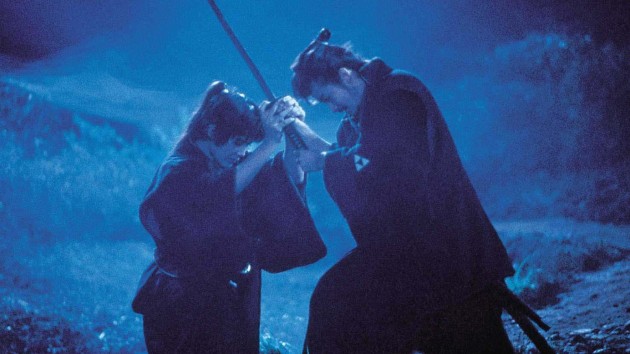
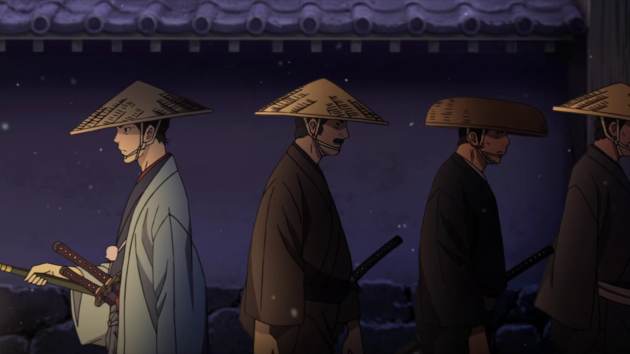
Katsugeki Touken Ranbu offers a similarly complex look at Japan’s warrior traditions, with a focus on important historical events that helped to shape modern Japan. The use of the sword in Katsugeki Touken Ranbu situates the series in periods of immense social, cultural, and political upheaval. The Japan it presents is one of constant struggle and change, whether that be the Onin Wars of the 15th century, or, more prominently, the Bakumatsu Period (1853-1867). It is a series that directly deals with the instabilities throughout Japan’s history, and presents its main cast ensuring that, regardless of the cost, the flow of historical events continue in order to preserve the future. It presents a particularly fascinating image of the historical samurai through its use of anthropomorphised swords. Izuminokami Kanesada (和泉守兼定), Mutsunokami Yoshiyuki (陸奥守吉行), Horikawa Kunihiro (堀川国広), Yagen Toushirou (薬研藤四郎), Tsurumaru Kuninaga (鶴丸国永), Tonbokiri (蜻蛉切), and Mikazuki Munechika (三日月宗近), represent weapons from Japan’s historical past; many of them were used by famous Japanese generals and Daimyo, and several, such as Tonbokiri (蜻蛉切), and Mikazuki Munechika (三日月宗近) embody legendary weapons (Mikazuki Munechika (三日月宗近) is one of the Five Swords Under Heaven (天下五剣), and considered one of the greatest Japanese swords ever made). As such the characters represent direct links to the historical past, and the central cast brings together weapons that were used by warriors from the Heian period through to the Bakumatsu, thus presenting an unbroken history of Japanese warrior traditions spanning over a thousand years. In doing so the series appears to suggest that only the tools of the day, weapons that have been instilled with the wishes and desires of their users can possibly defend Japan in the past. And despite the series use of time travel, and a number of more modern, or futuristic touches (small talking kitsune that appear to be anthropomorphised computers), it uses traditionally Japanese imagery; action scenes are deliberate and direct, actions that are complemented by Ufotable’s animation (the studio producing the series), adding visual flare to the fights between opposing warriors.
The sword (and spear) in this series is a tool for killing and defence, there is no thought of zen Buddhist quests and bettering oneself through the perfection of individual techniques. Instead Katsukgeki Touken Ranbu presents the sword in all of its murderous glory, suggesting that contemporary Japan is now starting to look at the historical samurai as something other than action heroes who eschewed social norms for the sake of inner peace, and has begun to look at them as a social group of warriors trained in the arts of killing. Japanesness in this respect is a question of history, and the roles samurai have played in shaping the socio-cultural and political institutions of the country. By depicting anthropomorphised swords defending Japan’s historical past from marauding ronin, Katsukgeki Touken Ranbu places the samurai and their arts at the very centre of Japanese socio-cultural belonging. Significantly, these noble warriors are not presented as jingoistic or excessively violent, but are rather portrayed as defenders of history and tradition, who only draw their swords when necessary, thus positioning the sword as a tool of defence, rather than one of aggression. In doing so the series suggests a reinterpretation and reintegration of samurai’s place in the modern Japanese state, whilst also indicating a reimagined vision of the historical samurai that focusses on a bond of brothers rather than an overly rigid hierarchical structure. While The Samurai Trilogy might deal with an idealised vision of Japan, whereby warriors can perfect their skills with the sword in a peaceful, and egalitarian society, Katsugeki Touken Ranbu presents these periods of instability as essential to the creation of the modern Japanese state. As with Gohatto, this series chooses to explicitly focus on periods of instability, where Japan was struggling with notions of modernity and what it meant to be a modern and forward-thinking nation.

In Gohatto Oshima questions the concept of ‘Japaneseness’ and Japan’s relationship with a modernity that was forced upon the nation by the appearance of Commodore Perry and his ‘Black Ships’ in 1853 (Yasuhara, 2007; 351). Oshima demonstrates the central contradiction of Japanesness in his portrayal of the Shinsengumi as a group that simultaneously wish to maintain the ‘Pax Tokugawana’, through a drive towards conservatism, while also pushing towards a more modern society (Yasuhara, 2007; 351). Furthermore, in his portrayal of the Shinsengumi, Oshima is further critiquing the current state of Japanese society and its push towards modernity, suggesting that the creation of a modern Japanese state has taken place by deliberately ignoring, or forgetting about the essential elements of the countries historical past (Mukae, 1996). Earlier Jidaigeki in the pre- and post-war periods reinforce Japan’s highly organized and hierarchical society; they glorify Japanese tradition through a canonisation of hierarchical family structures, particularly the patriarchal formations of bushido (William Davis, 1996). Oshima questions these hierarchic family structures in his portrayal of the Shinsengumi as a group, that while strict, embraced a spirit of ‘brotherhood’ or ‘doshi’, rather than reuse existing social structures and conventions. Which in turn represents a reinterpretation of the codes of brotherhood found in the tradition of shu-do, and broader understandings of bushido during the Edo-period and beyond.
While they were a group with a conservative outlook, aiming to repel foreigners and maintain the Tokugawa rule, they were also radical in their social and political position within Japanese society of the period. The shinsengumi was mainly founded by unemployed ronin rather than insitutionalised samurai, thus giving rise to a new class of swordsman, one that gains the status of insitutionalised samurai through their service to the Shogunate, rather than through their lineage. Although the shinsengumi consisted of ronin rather than samurai from known families and good lineage, they ultimately conformed to the social structures of the time, with the militias’ leaders (Isamu Kondo and Toshizo Hijikata) clearly inhabiting a different space and status to the rest (Yasuhara, 2007; 352). Furthermore, it was not Edo but Kyoto that allowed the Shinsengumi to gain the status and radicalism that allowed a group of ronin to work as a police force. Edo already had an established system of institutionalised warriors, whereas Kyoto was the centre of the anti-shogunate rebellion. Furthermore, while Edo represented the new capital, Kyoto was the seat of the imperial family, until it was moved to modern day Kyoto during the Meiji Restoration. By taking up residence in the old capital in order to defend against these forces, the shinsengumi’s violence was approved by the shogunate, so their social status was directly linked to authority, calling into question their social structures of equality and brotherhood (Yasuhara, 2007; 352). Such conformity is also common place within Jidaigeki anime, where individual characters are presented as equally skilled and important, while strict social structures and hierarchies are maintained and strengthened. Hasegawa Heizo in Onihei regularly acts as a ‘normal’ samurai, and is shown to don the persona of a ronin, or wandering rogue during a number of the series stories. Furthermore, he acts in a friendly, brotherly fashion around many of his subordinates, and many of his closest allies are ronin and rogues, as far from institutionalised samurai as it is possible to be. And yet, there is never any question of his authority, both as a samurai of some repute, and his relatively high status within Edo; for all his brotherly antics, there is never any illusion as to who holds the authority and power.

The irony of the militia as Yasuhara (2007) points out is that despite the Shinsengumi’s radicalism, one that stems from a ‘brotherhood among outsiders’, they are still assimilated to the patriarchal structure of Tokugawa feudalism, something that Oshima claimed in a 1995 interview to still exist in Japan today (Yasuhara, 2007; 353). Gohatto complicates this matter in ways that The Samurai Trilogy do not, Mifune’s Musashi never questions the moral or social ethics of his time, and the film focuses exclusively on his quest for fame, but also inner peace rather than looking at the social background of the period that he lived in. It is a film exclusively about its hero, whereas Oshima produces a jidaigeki that uses its characters to explore and problematise modern society and Japan’s focus on specific times and places in its history (Ienaga, 1993-1994). One of the most striking aspects of Gohatto is Oshima’s refusal to portray the Shinsengumi as a heroic, or archetypal Japanese militia by setting the film in 1865, a time of increased tension and political uncertainty.
By setting the film after the Ikeyada incident (Ikeyada jiken, 1864) that made the group famous, Oshima is able to focus on the Shinsengumi as a group full of contradictions while also demystifying the heroism that is found in so many other novels, films and TV programmes. Oshima once said ‘I no longer know who I am. That’s the subject of my films’ (Wilce, 2005). This remark calls into questions notions of ‘Japaneseness’ and Japanese modernity, by suggesting that despite the subject of his films, particularly Gohatto, Oshima was unsure of his own cultural identity; something that Gohatto suggests has come at the cost of Japan’s historical and cultural memory (Dennehy, 2008). It is easy to create a film about a hero or act of heroism that becomes emblematic of a particular aspect of Japanesness, but in doing so, these heroes like Miyamoto Musashi come to represent the very essence of the Japanese at the expense of everything else. The story of Miyamoto Musashi in The Samurai Trilogy, like many other post-war Jidaigeki focuses on mono no aware; the feeling of sweet sadness, or an almost inexpressible sensation of life’s mortality which is pleasantly painful, and is one of the foundations of Japanese aesthetic theory (Desser, 1992; 148). By focusing on ronin like Miyamoto Musashi, post-war Jidaigeki further engender feelings of mono no aware, through the portrayal of individuals who are without status, being buffeted about by the waves of fate, and who are utterly powerless yet proud (Desser, 1992; 149). Such figures never question society or the codifications of bushido that have given rise to their existence; trapped in the way of giri/ninjo (duty/human feelings), these figures choose the path of righteousness out of a sense of obligation without ever attacking the system itself (Desser, 1992).

By comparison, the mono no aware of Gohatto appears to be about the loss or ignorance of history and culture, with the presence of Kono Sozaburo and his effect on the Shinsengumi as representative of a place in history that has been ignored altogether (Rogers, 1990). Musashi chooses his own personal quest out of a sense of duty over his personal feelings for Otsu and is praised for it, whereas personal feelings in Gohatto appear to rip the close brotherhood of the Shinsengumi asunder. But, violent fights over the favours of beautiful young boys were not only a normal part of Samurai life during the Tokugawa period; they were often considered acceptable expressions of honorific sentiments (Ikegami, 1995; 209). There is no great divide between giri and ninjo in Gohatto as there is with Musashi’s tale, with personal feelings and duty overlapping and existing in the same space and time. The Shinsengumi’s duty to maintain the Tokugawa bakufu remains their most important role, but they do not stifle or suppress their own personal desires in order to do so. It is with the introduction of Sozaburo that this delicate balance starts to fall apart, with his presence creating an air of increased erotic tension as the camera focuses on his feminine looks, his sensuous lips, pale skin, wistful eyes and his long hair symbolising his adolescence. This close up is juxtaposed with his social background, where Sozaburo’s odd and out-of-place beauty within the Shinsengumi is intertwined with his background as the youngest son of one of Kyoto’s wealthiest merchants that still possess samurai heritage.
After nearly three centuries of Tokugawan Hegemonic rule, various systems and social divides had been created in order to stratify and control society, with the merchant classes occupying one of the lowest rungs. But, through trade, the merchant class had gained significant economic wealth, giving them more power, and greater adaptability than older, more traditional samurai families. They became the transnational group of Japan, with the ability, through their economic power to go beyond traditional ‘Japaneseness’ that was rooted in the feudalism of Tokugawa and earlier eras. Although the social actors of the Tokugawa period like the Shinsengumi struggled as best they could to make sense of the shifting socio-political environments cause by the slow decline of Tokugawa Hegemony, their responses and cultural adaptations failed to keep pace with the political changes themselves (Ikegami, 1995; 221). The merchant classes that Sozaburo comes from on the other hand were part of the modernisation of Japan, and through the opening up of the country and introduction of foreign goods, this class gained an increasingly important role in the development and change of Japan from a feudal to a modern society (Cameron Hurst III, 1990). By having Sozaburo come from a merchant family, and yet be a part of the traditional, conservative, but also radical Shinsengumi, Oshima further problematises notions of Japanesness. It is shown to be a combination of things, both old and new, it is therefore wrong to reduce Japanesness to a single state of mind or time period like we see in The Samurai Trilogy.

Inagaki’s Musashi Trilogy presents a single moment of Japanese history as if it were timeless, with Japanese culture and society portrayed as unchanging and wholly unique. The use of iconic imagery like sakura blossom, classical Japanese architecture, and highly stylized combat feeds into what Bellah (2003) calls ‘national narcissism’, whereby the Japanese are constantly looking inwardly in order to find evidence from the historical past of their countries uniqueness (Bellah, 2003; 114). Oshima plays with the concept of ‘national narcissism’ by using iconic imagery of Japan as a backdrop for the increasingly complex nature of the Shinsengumi. In doing so he calls to attention the problematic nature of such symbolism by demonstrating that while the sakura may stay the same, society and culture move on and change. If we only focus on such imagery, the complexities of a society and culture that are in a constant state of flux are ignored and forgotten about, so what becomes symbolic of Japan has actually been alienated from its surroundings and bares little resemblance to what it supposedly represents (Moeran, 1990). By introducing Sozaburo who inhabits the space between the traditional and the transnational, Oshima seems to suggest that ‘Japaneseness’ is not a single moment frozen in time, but a constantly changing and evolving idea, one that is the culmination of centuries of change. It can further be argued that there is no one version of ‘Japaneseness’, and that the myriad of characters within Gohatto all have their own versions of what it means to be Japanese that take into account their own cultural, social and political backgrounds.
Also, because of this, the process of modernisation and change is shown to be gradual rather than a sudden reaction to the Meiji restoration. Which is not to say that nothing is lost through change, with bushido and shu-do being cast aside and viewed as a part of the degenerate past (Robertson, 1992). Modernity is not however a completely new start, instead it can be viewed as a change of perspective, with well-worn social norms remaining, but shown in a different guise (Lehmann, 1984). Sozaburo is representative of the transnational other that proceeds and is a part of modernity, a character that remains within the samurai tradition, but who also comes from a social background that allows him to move between the traditional and the new. In representing Japanese history as a ‘complex intersection of conflicted sexualities and political institutions and discourses’ (Nygren, 2004; 540), Oshima demonstrates the highly restrictive nature of Japaneseness and its inability to adapt to a changing environment. By setting Gohatto in Kyoto 1865, an in-between space where Japan’s pre-modernity and modernity overlap, Oshima questions the patriarchy inherent in the Shinsengumi and broader Japanese society through the use of Sozaburo’s eroticism (Yasuhara, 2007; 355).
This eroticism resonates with Bataille’s (1962) theory of eroticism as aesthetic of subversion whereby eroticism entails a breaking down of established patterns of the regulated social order basic to our mode of existence as defined and separate individuals (Bataille, 1962; 18). The eroticism of Sozaburo becomes a threat to the unity and harmony of the Shinsengumi, and comes to represent how ill-equipped they and the broader Japanese traditions are to deal with change. His social ambiguity and sensuality first stir up disorder within the close knit Shinsengumi, but in the end the militias’ hierarchy ultimately eliminates him in an effort to restore order. Sozaburo’s individuality and social ambiguity represents a new Japan that threatens the close-knit group ethos that the Shinsengumi are duty bound to protect (Robertson, 1992). His downfall and death can be viewed as the traditional ‘Japaneseness’ of the Shinsengumi attempting to reassert its authority over a society and culture that has already changed. When Hijikata cuts down a young cherry tree at the end of the film, exclaiming ‘Sozaburo was too beautiful. Men took advantage of him. He was possessed by evil’, Oshima suggests that this gesture symbolises the destiny of a samurai (Tessier, 2000; 15). The death of Sozaburo at the hands of Captain Okita – whose job it is to keep order within the Shinsengumi – followed by Hijikata cutting the cherry tree implies the eradication of a growing intranational other that represents a different Japan, one that subverts the patriarchy of tradition (Yasuhara, 2007; 356). Sozaburo’s reified eroticism and ability to move between the modern and the traditional represents a Japan that is unacceptable and incompatible with conservative tradition, whereas Musashi’s personal quest comes to represent a Japan that has a long tradition of thought and aesthetics which are unique acceptable.
Jidaigeki anime like Katsugeki Touken Ranbu by comparison presents us with an entire cast of handsome, and at times beautiful men, characters that have more in common with a modern boy band than images of experienced warriors. As such this series inhabits a curious space whereby the beauty and eroticism of these characters does not threaten the harmony of the group, and instead is presented as the norm. The imagery used in this series serves as a bridge between the historical samurai and a modern aesthetic – furthermore, to see such handsome characters cutting through hordes of ‘evil’ warriors suggests a reinterpretation of what a samurai could be, and what they may look like. Their delicate touch and sublime skill further highlight’s the brilliant beauty of their martial prowess. Their clothes are aesthetically pleasing to the eye, borrowing from various known Japanese aristocratic fashions from the Heian period through to the Edo-era, this coupled with the subtle, but simultaneously beautiful sword techniques of each character firmly anchor this series in the classically Japanese aesthetic tradition. Such imagery is reinforced through the imagery employed when these anthropomorphised swords initially arrive in the past surrounded by a storm of cascading sakura blossom. Such iconic imagery has been employed by jidaigeki anime and cinema to reinforce the importance or Japan’s aesthetic tradition, and anchor their narratives in a distinctly Japanese past.

This then suggests a continued yearning in contemporary Japanese society for an (apparently) simpler time, alongside a need to further anchor modern Japan in a historical past that continues to embody the origins of Japan’s social and cultural traditions. Thus, the quest to protect the historical past from a marauding presence with unclear goals is arguably an implicit desire for a uniquely Japanese history untainted, and perfectly preserved. Their central dilemma then is that in the process of protecting the future from this marauding presence, these figures will ultimately witness the deaths of numerous other ‘innocents’, thus subtly changing Japan’s history in small, but important ways. However, these issues are largely blamed on the Jikan Sokōgun (時間遡行軍, lit. ‘Time Retrograde Army’), a destructive outside other than seeks to change Japan for unknown reasons. Importantly, rather than the Jikan Sokōgun appearing as westerners, they are instead characterised as marauding ronin, dishevelled warriors with unkempt hair, and damaged armour. Such imagery is juxtaposed with the imagery used for the main cast, complete with kimono and other forms of ‘traditional’ dress taken from the Heian period onwards. Such imagery is arguably analogous to the dilemmas facing the Shinsengumi in Gohatto, as they try to protect the past from modernity that has already passed them by. These swords must protect Japan’s history from a future that they are incapable of dealing with as historical artefacts, and they violence serves as the only action they are capable of as historical swords intimately linked with Japan’s warrior tradition.
Jidaigeki anime inhabits an increasingly complex space within Japanese culture. On the one hand they are contemporary reimagining’s of the historical past, complete with modern language (although older forms of Japanese are becoming more prevalent in recent years), and characters that can often have more in common with inner-city street gangs in manners and language, than they do with their historical counterparts. As such they appear to be suggesting a reformulation of Japaneseness that uses the historical past to underpin the modern world, a search for an origin to culture and social structures. In this respect, these series emulate and elevate traditional culture and traditions, further suggesting that in these settings a modern audience can find ‘proper’ Japanese culture. Sa-do, sho-do, and ka-do are referenced in every series, often on a regular basis, and immature characters are highlighted through their lack of understanding regarding Japanese traditional crafts and ceremonies. Such reverence is presented as natural, and proper, while the social structures that allowed for such deeply complex, and highly ritualised traditions to flourish are rarely, if ever mentioned.

Japaneseness in post-war Jidaigeki is made up of cultural and social traditions that are deemed to be acceptable and representative of a country with unique socio-cultural traditions. The portrayal of Miyamoto Musashi in The Samurai Trilogy becomes emblematic of a social and cultural aesthetic that is seen to be above everything else an unchanging example of true Japaneseness. Inagaki isn’t questioning how Japan is portrayed, but is instead creating an exciting adventure about the life of a cultural hero whose central dilemma still resonates in Japan today. The Japan of Musashi’s time is not explored and merely serves as a backdrop for his own deeply personal quest, and as such is seen to be a country with few complications or problems. Political uprisings, civil unrest and deeply engrained cultural practices such as shu-do are ignored for the sake of Musashi’s journey of discovery, so that we get a significantly less complicated and complex portrayal of Tokugawan Japan. The great process of westernisation and modernisation from the Meiji Restoration (1868) onwards was at the same time a rejection and forgetting of cultural traditions and attitudes that were deemed to be unfit for a modern nation, or simply viewed as old-fashioned. What was left were the acceptable elements that helped to portray Japan as a unique and above all strong country, one with an unbroken heritage of martial success and a deeply engrained set of cultural traditions that could set Japan apart from the rest of the world. Japaneseness in this context is something that is uncomplicated and fits into the modern interpretation and portrayal of Japanese history and culture with such films such as The Samurai Trilogy sticking to it almost religiously.
By comparison, Oshima portrays Japan to be a complex country and society, one with a deep cultural heritage that, like any other country has changed over the years. In particular, his use of homosexuality and the portrayal of shu-do take us back to a time before it was considered a deficiency or sexual anomaly, to a period in Japanese history when it was one of the great aesthetic traditions. Setting the film in Kyoto 1865, while also focusing on the Shinsengumi, a group that are traditionally used to depict a heroic and strong Japan that has sadly been lost, Oshima is able to explore the complex nature of modernity in Japan and notions of Japaneseness. Instead of being portrayed as a heroic, almost mythic group of warriors, the Shinsengumi are instead a group that struggle with their own conservatism and radical roots. Tradition and ‘Japaneseness’ become concepts that can be twisted and manipulated at will to fit in with national agendas and therefore far from being fixed. Gohatto points to the irony and contradiction in Japanese modernity as it reaches into the historical past to find immutable facts of Japan’s greatness. Through the character of Sozaburo we see a country that has an ambivalent attitude towards modernity, and one that will willingly embrace it when convenient or dispose of it when it is not.

Jidaigeki anime, then, inhabit a complicated middle ground, simultaneously reinforcing the restrictive, and uncomplicated vision of the historical past free from cultural and social complexities, whilst also reformulating the image of the samurai to fit contemporary sensibilities. They are conservative in nature, and yet radical in execution, thus suggesting that Japanesness is not as straightforward as one might believe, and is something that changes over time. That there are so many anime series, and films that focus on samurai also indicates their continued importance to the Japanese sense of history and belonging. They are the ancestors and creators of the Japanese state, and are therefore immensely important to the Japanese socio-cultural identity. It also suggests a further reformulation of the bushido code to fit a contemporary audience, one that continues to focus on the honourable and just elements while excluding the jingoistic excesses of the pre-war years. As with Gohatto, tradition and Japaneseness become concepts that can be twisted and manipulated at will to fit with the individual series agendas, and are therefore highly malleable and complex ideas. However, unlike Gohatto, rarely do we see a Jidaigeki anime point out the irony and contradiction in using the historical past to provide immutable facts of Japan’s greatness. Instead they inhabit a contradictory space between the post-war Jidaigeki, and more complex films like Oshima’s Gohatto; simultaneously radical, yet conservative in their social outlook and depiction of samurai.
Concepts of Japaneseness are therefore far more complex than most post-war Jidaigeki might suggest, with certain elements of Japanese history conveniently forgotten about, while others become central to the creation of an official Japanese identity. By picking and choosing which parts of history you wish to cover, we see only a partial picture, a mere glimpse at what it means to be Japanese. The Samurai Trilogy, like other post-war Jidaigeki take part in a revisionist interpretation and portrayal of Japanese history and culture, one that ignores face when convenient and focuses on elements that are viewed to be a true, and above all, acceptable version of Japaneseness. By comparison, Oshima revises this history and injects elements of Japan’s cultural and aesthetic traditions into his narrative that were rejected in the surge towards modernity as representing a backwardness that did not befit a modern nation state. Gohatto is however, not a true portrayal of Japan, but instead of using the cultural and visual aesthetics of the jidaigeki genre to retell the same sort of samurai story that further reinforces long held notions of Japaneseness, Oshima questions them. Further complexities are created with Jidaigeki anime, and more recent additions that represents a continued interest in the historical past, alongside the enduring appeal, and importance of the samurai in the creation of a Japanese national identity. However, they inhabit an uneasy space; simultaneously radical, yet conservative, suggesting that it is possible to create a contemporary samurai story that resonates with a modern audience, while also elevating and emphasising the importance of particular imagery and elements of samurai culture over everything else. Because, while there are more radical elements in these series – a greater focus on straightforward fights, and an inclusion of a broader segment of Tokugawan society in particular – they are still selective when it comes to the parts of Japanese history that are presented to the viewer, thus returning to the acceptable Japanesness of earlier post-war jidaigeki like The Samurai Trilogy. Between Gohatto, post-war jidaigeki, and more recently, Jidaigeki anime, we see a picture of Japaneseness that is full of complexities and insecurities; we see a country that struggles with its place in the world, and one, which has an ambiguous relationship with the very culture and history that it uses to reinforce its own uniqueness and greatness.

Bibliography:
Bataille, G. (1962), Death and Sensuality: A Study of Eroticism and the Taboo, Walker; New York.
Befu, H. (2001), Hegemony and Homogeneity: An Anthropological Analysis of ‘Nihonjinron’, Trans Pacific Press; Melbourne
Bellah, R.N. (2003), Imagining Japan, The Japanese Tradition and its Modern Interpretation, University of California Press; Berkley and Los Angeles California.
Blomberg, C. (1994), The Heart of the Warrior, Origins and Religious Background of the Samurai System in Feudal Japan, Japan Library; Folkestone, Kent.
Bukh, A. (2007), Japan’s History Textbooks Debate: National Identity in Narratives of Victimhood and Victimisation, Asian Survey, Vol.47(5), pp. 683-704.
Buruma, I. (1984), A Japanese Mirror, Heroes and Villains of Japanese Culture, Atlantic Books; London.
Caldararo, N. (2003), The Concept of the Sustainable Economy and the Promise of Japan’s Transformation, Anthropological Quarterly, Vol.76(3), pp. 463-478.
Cameron Hurst III, G. (1990), Death, Honour, and Loyalty: The Bushido Ideal, Philosophy East and West, Vol.40(4), pp. 511-527.
Casebier, A. (1987), College Course File: Japanese Film and Culture, Journal of Film and Video, Vol.39(1), pp. 52-64.
Creighton, M. (1997), Consuming Rural Japan: The Marketing of Tradition and Nostalgia in the Japanese Travel Industry, Ethnology, Vol.36(3), pp. 339-254.
Dennehy, K. (2008), Incorporating Japan into the World History Curriculum: An Integrative Model, The History Teacher, Vol.41(3), pp. 321-338.
Desser, D. (1992), Toward a Structural Analysis of the Postwar Samurai film, in Arthur N, JR. and David, D. (eds.) Reframing Japanese Cinema, Authorship, Genre, History, Indian University Press; Indianapolis.
Friday, K. F. (1994), Bushido or Bull? A Medieval Historian’s Perspective on the Imperial Army and the Japanese Warrior Tradition. The History Teacher, Vol.25(3), pp. 339-349.
Galloway, P. (2005), Stray Dogs & Lone Wolves, The Samurai Film Handbook, Stone Bridge Press; Berkeley, California.
Gerstle, C.A. (1997), Heroic Honour: Chikamatsu and The Samurai Ideal, Harvard Journal of Asiatic Studies, Vol.57(2), pp. 307-381.
Grossman, A. (2001), ‘Gohatto, or the End of Oshima Nagisa?’, Bright Lights Film Journal, Vol.33(25).
Hook, G.D. & Hiroko, T. (2007), ‘Self-Responsibility’ and the Nature of the Postwar Japanese State: Risk Through the Looking Glass, Journal of Japanese Studies, Vol.33(1), pp. 93-123.
Ikegami, E. (1995), The Taming of the Samurai, Honorific, individualism and the Making of Modern Japan, Harvard University Press; London, England.
Ienaga, S. (1993-1994), The Glorification of War in Japanese Education, International Security, Vol.18(3), pp. 113-133.
Lehmann, J.P. (1984), Old and New Japonisme: The Tokugawa Legacy and Modern European Images of Japan, Modern Asian Studies, Vol.18(4), pp. 757-768.
Moeran, B. (1990), Japanese Ceramics and the Discourse of ‘Tradition’, Journal of Design History, Vol.3(4), pp. 213-225.
Mukae, R. (1996), Japan’s Diet Resolution on World War Two: Keeping History at Bay, Asian Survey, Vol.36(10), pp. 1011-1030.
Nygren, S.R. (2004), The Flash of Capital: Film and Geopolitics in Japan, The Journal of Japanese Studies, Vol.30(2), pp. 538-542.
Reynolds, J.M. (2001), Ise Shrine and a Modernist Construction of Japanese Tradition, The Art Bulletin, Vol.83(2), pp. 316-341.
Robertson, J. (1992), The Politics of Androgyny in Japan: Sexuality and Subversion in the Theatre and Beyond, American Ethnologist, Vol.19(3), pp. 419-422.
Selden, M. (2008), Japan, the United States and Yasakuni Nationalism, Economic and Political Weekly, Vol.43(45), pp. 71-77.
Silver, A. (1977), The Samurai Film, The Tantivy Press; London, England.
Tessier, M. (2000), ‘Interview with Nagisa Oshima’, http://www.kitanotakeshi.com/pdf/1104143782_taboo_pk.pdf – accessed April 5th 2013.
Thornton, S.A. (2008), The Japanese Period Film, A Critical Analysis, McFarland & Company, Inc., Publishers; Jefferson, North Carolina, and London.
Watanabe, J. & Iwata, J. (1989), The love of the samurai, a thousand years of Japanese homosexuality, Alyson Publications; Boston.
Wilce, M. (2005), ‘Big in Japan: Oshima Nagisa’, http://archive.metropolis.co.jp/biginjapanarchive299/289/biginjapaninc.htm – accessed April 1st 2013.
William Davis, D. (1996), Picturing Japaneseness, Monumental style, National Identity, Japanese Film, Columbia University Press; New York.
Yasuhara, Y. (2007), Nagisa Oshima’s Vast Historical Project and Theme of Homoeroticism in Taboo (Gohatto), Literature/Film Quarterly, Vol.35(1), pp. 350-357.


 illogicalzen